



Sodium Channel
Na channels; Na+ channels
Sodium channels are integral membrane proteins that form ion channels, conducting sodium ions (Na+) through a cell's plasma membrane. They are classified according to the trigger that opens the channel for such ions, i.e. either a voltage-change (Voltage-gated, voltage-sensitive, or voltage-dependent sodium channel also called VGSCs or Nav channel) or a binding of a substance (a ligand) to the channel (ligand-gated sodium channels). In excitable cells such as neurons, myocytes, and certain types of glia, sodium channels are responsible for the rising phase of action potentials. Voltage-gated Na+ channels can exist in any of three distinct states: deactivated (closed), activated (open), or inactivated (closed). Ligand-gated sodium channels are activated by binding of a ligand instead of a change in membrane potential.
Sodium Channel Isoform Specific Products
-
Sodium Channel
(629)
View all products
-
Nav1.1
(11)
View all products
-
Nav1.2
(16)
View all products
-
Nav1.3
(14)
View all products
-
Nav1.4
(14)
View all products
-
Nav1.5
(21)
View all products
-
Nav1.6
(12)
View all products
-
Nav1.7
(61)
View all products
-
Nav1.8
(41)
View all products
-
Nav1.9
(2)
View all products
All Product Categories
-
Sodium Channel Inhibitors
(619)
View all products
-
Sodium Channel Agonists
(10)
View all products
-
Sodium Channel Antagonists
(30)
View all products
-
Sodium Channel Activators
(35)
View all products
-
Sodium Channel Modulators
(30)
View all products
-
Sodium Channel Controls
(5)
View all products
-
Sodium Channel Ligands
(3)
View all products
-
Sodium Channel Related Products (802)
Related Products (802)

-
Antibodies (9)
-
Related Compound Screening Libraries (1)
-
Sodium Channel Isoform Comparison
-
Sodium ionophore III (Standard)
 0 ImagesCat. No.: HY-101109RCAS No.: 81686-22-8Synonyms: ETH2120 (Standard)Sodium ionophore III (Standard) is the analytical standard of Sodium ionophore III (HY-101109). This product is intended for research and analytical applications. Sodium ionophore III (ETH2120) is a Na+ ionophore suitable for the assay of sodium activity in blood, plasma, serum. etc.
-
γ-Kainylglutamic acid
 0 ImagesCat. No.: HY-118758CAS No.: 98394-38-8Synonyms: γ-Kainic acid-glutamic acidγ-Kainylglutamic acid (γ-Kainic acid-glutamic acid), a dipeptide derived from kainic and L-Glutamic acids, is a selective antagonist of amino acid induced neuroexcitation with anticonvulsant properties. γ-Kainylglutamic acid inhibits the stimulation of Na+ fluxes induced in brain slices by the neuroexcitant N-methyl-D-aspartic acid. γ-Kainylglutamic acid is also effective in protecting mice from picrotoxin-induced convulsions with an EC50 value of 0.17 μmol.
-
Flecainide (Standard)
 0 ImagesFlecainide (Standard) is the analytical standard of Flecainide. This product is intended for research and analytical applications. Flecainide is an orally active antiarrhythmic agent. Flecainide can block sodium channels and inhibit calcium ion release mediated by the cardiac ryanodine receptor (RyR2). Flecainide can be used in the research of diseases such as catecholaminergic polymorphic ventricular tachycardia (CPVT).
-
Insecticidal agent 34
 0 ImagesCat. No.: HY-206897CAS No.: 183992-66-7Insecticidal agent 34 is an orally active insecticide. Insecticidal agent 34 inhibits voltage-gated sodium channel and blocks acetylcholine release. Insecticidal agent 34 induces ataxia, paralysis, curling, tremors/convulsions and progressive death in lepidopteran larvae, inhibits neural activity in the central nervous system, and blocks nerve firing in larval stretch receptor preparations. Insecticidal agent 34 can be used for insecticidal research.
-
PD 122860
 0 ImagesCat. No.: HY-124229CAS No.: 122576-86-7PD 122860 is a calcium channel blocker. PD 122860 also can stimulate sodium channel. PD 122860 can be used for the research of cardiovascular and cerebrovascular diseases.
-
Lidocaine-d6
 0 ImagesCat. No.: HY-B0185S2CAS No.: 1215823-29-2Synonyms: Lignocaine-d6Lidocaine-d6 (Lignocaine-d6) is deuterium labeled Lidocaine. Lidocaine (Lignocaine) inhibits sodium channels involving complex voltage and using dependence. Lidocaine decreases growth, migration and invasion of gastric carcinoma cells via up-regulating miR-145 expression and further inactivation of MEK/ERK and NF-κB signaling pathways. Lidocaine is an amide derivative and has potential for the research of ventricular arrhythmia.
-
Ropivacaine (Standard)
 0 ImagesRopivacaine (Standard) is the analytical standard of Ropivacaine. This product is intended for research and analytical applications. Ropivacain is a potent sodium channel blocker. Ropivacain blocks impulse conduction via reversible inhibition of sodium ion influx in nerve fibrese. Ropivacaine is also an inhibitor of K2P (two-pore domain potassium channel) TREK-1 with an IC50 of 402.7 μM in COS-7 cell's membrane. Ropivacaine is used for the research of neuropathic pain management.
-
Piromelatine (Standard)
 0 ImagesSynonyms: Neu-P11 (Standard)Piromelatine (Standard) is the analytical standard of Piromelatine. This product is intended for research and analytical applications. Piromelatine (Neu-P11) is a melatonin MT1/MT2 receptor agonist, serotonin 5-HT1A/5-HT1D agonist, and serotonin 5-HT2B antagonist. Piromelatine (Neu-P11) possesses sleep promoting, analgesic, anti-neurodegenerative, anxiolytic and antidepressant potentials. Piromelatine (Neu-P11) also possesses pain-related P2X3, TRPV1, and Nav1.7 channel-inhibition capacities.
-
Atomoxetine hydrochloride (Standard)
 0 ImagesSynonyms: Tomoxetine hydrochloride (Standard); (R)-Tomoxetine hydrochloride (Standard); LY 139603 (Standard)Atomoxetine (hydrochloride) (Standard) is the analytical standard of Atomoxetine (hydrochloride). This product is intended for research and analytical applications. Atomoxetine (Tomoxetine) hydrochloride is a selective noradrenaline reuptake inhibitor with Ki values of 5 nM, 77 nM and 1451 nM for norepinephrine (NE), serotonin (5-HT) and dopamine (DA) transporters, respectively. Atomoxetine hydrochloride is a potent Na+ channels (VGSCs) blocker. Atomoxetine hydrochloride can be used for attention-deficit hyperactivity disorder (ADHD) research.
-
GMQ hydrochloride (Standard)
 0 ImagesCat. No.: HY-107757RCAS No.: 5361-15-9Synonyms: 2-Guanidine-4-methylquinazoline hydrochloride (Standard)GMQ hydrochloride (Standard) is the analytical standard of GMQ (hydrochloride) (HY-107757). This product is intended for research and analytical applications. GMQ (hydrochloride) is a ASIC (acid-sensing ion) channel activator with an EC50 value of 1.83 mM for ASIC3 at pH 7.4. GMQ (hydrochloride) opens only ASIC3 but no other ASICs at pH 7.4. GMQ (hydrochloride) can be used for neurological disease research.
-
Cyphenothrin
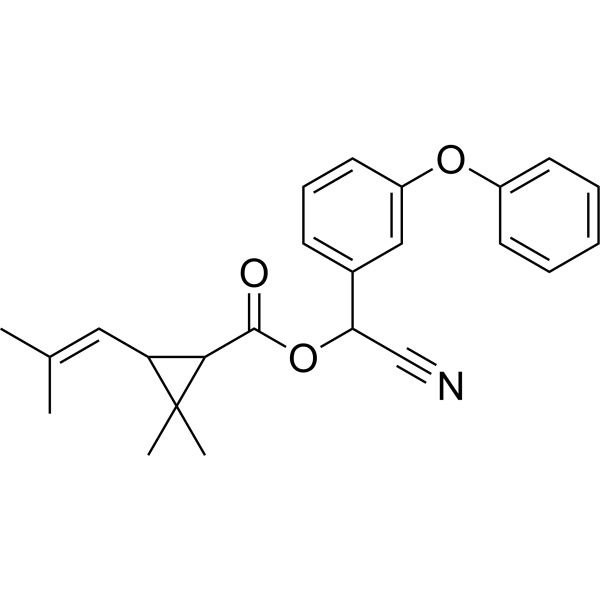 0 ImagesCat. No.: HY-119335CAS No.: 39515-40-7Synonyms: S-2703Cyphenothrin (S-2703) is a pyrethroid pesticide. Cyphenothrin acts on the neuromuscular system of insects, intervening in the gating mechanism of sodium channels.
-
Ralitoline
 0 ImagesCat. No.: HY-106747CAS No.: 93738-40-0Ralitoline is a sodium channel blocker with IC50 of 2 μM. Ralitoline has anticonvulsant activity.
-
Eleclazine hydrochloride (Standard)
 0 ImagesSynonyms: GS 6615 hydrochloride (Standard)Eleclazine (hydrochloride) (Standard) is the analytical standard of Eleclazine (hydrochloride). This product is intended for research and analytical applications. Eleclazine (GS 6615) hydrochloride is a selective cardiac late sodium current inhibitor and a weak inhibitor of potassium current with IC50 value of <1 μM and approximately 14.2 μM, respectively. Eleclazine hydrochloride shows concurrent protection against autonomically induced atrial premature beats, repolarization alternans and heterogeneity, and atrial fibrillation in porcine model. Eleclazine hydrochloride can be used to research cardiac arrhythmias.
-
Clopamide (Standard)
 0 ImagesClopamide (Standard) is the analytical standard of Clopamide. This product is intended for research and analytical applications. Clopamide is an orally active thiazide-like diuretic agent that inhibits the sodium-coupled chloride cotransporter SLC12A3. Clopamide has the potential for hypertension and cardiac failure research.
-
PF-05241328 (Standard)
 0 ImagesCat. No.: HY-103623RCAS No.: 1387633-03-5PF-05241328 (Standard) is the analytical standard of PF-05241328 (HY-103623). This product is intended for research and analytical applications. PF-05241328 is a potent and selective inhibitor of human Nav1.7 voltage-dependent sodium channels (Nav1.7), with an IC50 of 31 nM.
-
Vincanol
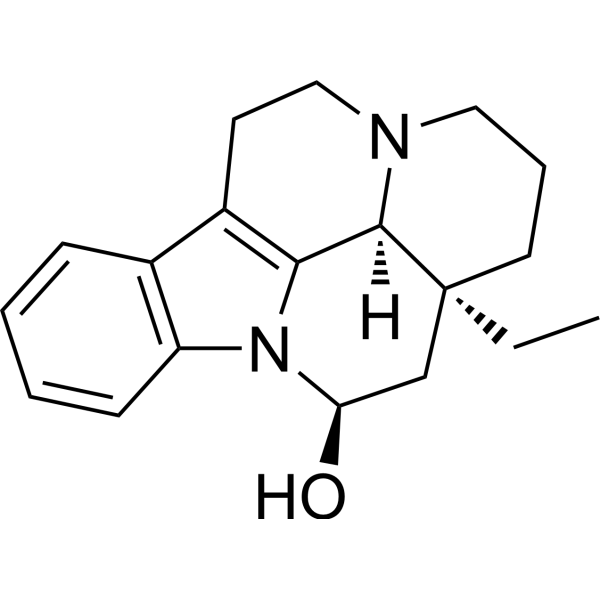 0 ImagesCat. No.: HY-124925CAS No.: 19877-89-5Synonyms: (-)-Isoeburnamine; (-)-epi-EburnamineVincanol ((-)-Isoeburnamine) is a blocker of voltage-gated Na+ channels. Vincanol blocks Na+ currents with an IC50 value of 40 μM. Vincanol has neuroprotective effect.
-
Ranolazine (Standard)
 0 ImagesCat. No.: HY-B0280RCAS No.: 95635-55-5Synonyms: CVT 303 (Standard); RS 43285-003 (Standard)Ranolazine (Standard) is the analytical standard of Ranolazine. This product is intended for research and analytical applications. Ranolazine (CVT 303) is an anti-angina drug that achieves its effects by inhibiting the late phase of inward sodium current (INa and IKr with IC50 values of 6 μM and 12 μM, respectively) without affecting heart rate or blood pressure (BP). Ranolazine is also a partial fatty acid oxidation (FAO) inhibitor. Antianginal agent.
-
Licarbazepine-d3
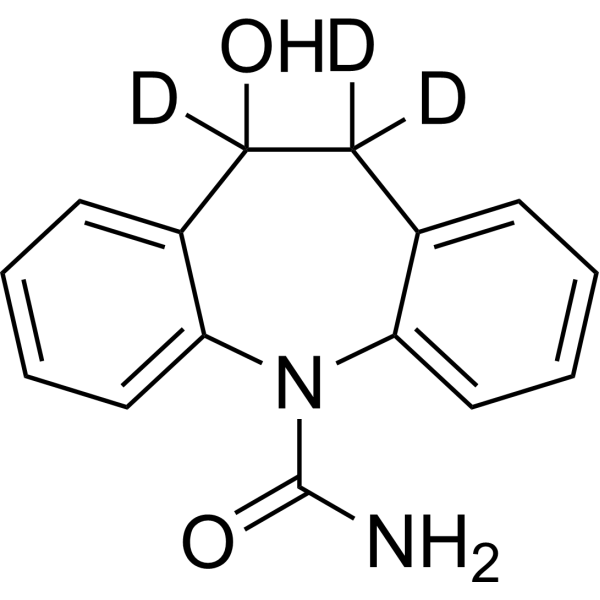 0 ImagesCat. No.: HY-108506SCAS No.: 1189917-36-9Synonyms: BIA 2-005-d3; GP 47779-d3Licarbazepine-d3 is the deuterium labeled Licarbazepine (HY-108506). Licarbazepine is a voltage-gated sodium channel blocker with anticonvulsant and mood-stabilizing effects.
-
TC-N 1752 (Standard)
 0 ImagesCat. No.: HY-107405RCAS No.: 1211866-85-1TC-N 1752 (Standard) is the analytical standard of TC-N 1752 (HY-107405). This product is intended for research and analytical applications. TC-N 1752 is a potent and orally active inhibitor of Nav1.7, with IC50s of 0.17 μM, 0.3 μM, 0.4 μM, 1.1 μM and 2.2 μM at hNav1.7, hNav1.3, hNav1.4, hNaV1.5 and rNav1.8, respectively. TC-N 1752 also inhibits tetrodotoxin-sensitive sodium channels. TC-N 1752 shows analgesic efficacy in the Formalin model of pain.
-
Quinacrine (Standard)
 0 ImagesQuinacrine (Standard) is the analytical standard of Quinacrine. This product is intended for research and analytical applications. Quinacrine (Acriquine) is an antimalarial and anti-cancer agent. Quinacrine also inhibits human aldehyde oxidase (IC50: 3.3 μM). Quinacrine has affinity for nucleic acids, and stains DNA and RNA in fixed cells (Ex/Em: 436/525 nm).




